 EN
EN  English
 Español

News
 Home / Blogs / Industry News / Advances in Automotive Shock Absorber Technology: What Changed and What to Buy
 Advances in Automotive Shock Absorber Technology: What Changed and What to Buy
 2026.10.14
 Industry News
A 2026-model electric mid-size SUV carries roughly 350 to 400 kg more sprung mass than the combustion version it replaced, and it does so on damper bodies only a few millimetres longer. That packaging squeeze explains why advances in automotive shock absorber technology have moved faster in the past decade than in the previous forty: chassis engineers needed more control authority without more space, and parts buyers now inherit hardware that behaves very differently from the dampers of the 2010s.
For distributors, workshops and importers, the useful question is not which technology sounds the most advanced, but which advances change what you stock, how you quote a job and how long the part survives in service. The sections below separate production hardware from concept-stage engineering.
Which Advances in Automotive Shock Absorber Technology Reached Production
Four damper families account for nearly all production hardware built today: twin-tube dampers with amplitude-selective valving, high-pressure monotube gas dampers, electronically controlled semi-active dampers, and air-assisted or fully active systems that remain limited to premium and commercial segments.
Semi-active is the category that matters most to parts professionals, because it has already moved from flagship saloons into mid-market crossovers and light commercial vehicles.
Semi-active damping: an electronic controller alters the damper force curve in real time, but the damper can only resist suspension movement. It never adds energy to the chassis, which is why it costs a fraction of a fully active system and draws only a few watts.
- Amplitude-selective valving opens a secondary bleed path on short, high-frequency inputs such as expansion joints, then closes it under body roll or braking dive.
- A high-pressure monotube gas charge, normally nitrogen at 10 to 25 bar, keeps the oil column pressurized and suppresses foaming and fade.
- Magnetorheological fluid aligns iron particles in a magnetic field and shifts yield stress within roughly 5 to 15 milliseconds.
- Solenoid proportional valves vary the orifice size instead, typically responding within 10 to 20 milliseconds.
- Complete strut assemblies package damper, spring, mount and bearing as one pre-assembled unit, removing spring compressors from the job entirely.
Valve Response Time Is What Separates Real Adaptive Damping from Marketing
A semi-active damper only outperforms a well-tuned passive unit when it can change state in about 10 milliseconds or less, because the body motions passengers notice sit between 1 and 2 Hz while wheel-hop inputs sit above 10 Hz.
Miss that window and the electronics simply react after the event. The chart below shows indicative response ranges for the three mainstream adjustable architectures.
Indicative valve response time, milliseconds, lower is better
Mechanical amplitude-selective valve
25-40 ms
Solenoid proportional valve
10-20 ms
Magnetorheological fluid
5-15 ms
Two practical consequences follow. First, a magnetorheological damper and a fast solenoid damper feel broadly similar on a test route, so fluid type alone is not a quality signal. Second, vehicles that use purely mechanical amplitude-selective valves still capture most of the comfort gain at a fraction of the cost, which is why that design now dominates replacement catalogues.
10 ms
The point at which electronic damping starts to feel measurably different from good passive tuning on a 1 to 2 Hz body input.
Twin-Tube, Monotube and Strut Assembly: What Each Format Changes
A monotube damper sheds heat faster and resists fade longer, while a twin-tube damper is quieter, shorter and cheaper to build. Neither wins outright, because duty cycle decides which one survives.
| Attribute | Twin-tube | Monotube | Complete strut assembly |
| Gas charge | 4 to 8 bar | 10 to 25 bar | Matches the damper fitted |
| Heat dissipation | Moderate, oil circulates in the outer tube | High, oil contacts the housing wall directly | Inherits the inner damper design |
| Ride character | Softer and quieter | Firmer, more controlled | Soft when mounts and bearings are new |
| Fade resistance | Drops under sustained hard use | Best of the three formats | Determined by the inner damper |
| Installation | Spring transfer required | Spring transfer required | Fastest, arrives pre-assembled |
| Typical duty | Passenger cars, light vans | Performance, off-road, heavy duty | Workshop replacement on ageing vehicles |
Choose a monotube when
- The vehicle tows or carries load most of the week
- High-speed stability matters more than cabin isolation
- Wheel travel and heat build-up are high
- Repeated hard braking from highway speed is normal
Choose a twin-tube when
- Comfort is the first buying criterion
- Packaging space around the wheel arch is tight
- The program is volume-sensitive on cost
- Road noise and harshness complaints are common
Gerep Automotive Parts Mfg Co., Ltd. (Gerep) builds both formats and adds a third service option: a complete strut assembly that ships with spring, mount and bearing already fitted, so a two-hour spring transfer becomes a thirty-minute bolt-on job.
Frequency-Selective Valving and the Real Replacement Window
Amplitude-selective and frequency-selective valves deliver most of the comfort benefit of electronics with no wiring, no sensors and no calibration map.
The mechanism is mechanical. A blow-off disc or an extra bleed path opens on short, low-amplitude inputs and drops force by 30 to 50 percent, which softens the ride over broken surfaces. When the input grows, the valve closes and force returns for cornering and load transfer. The result is a damper that feels compliant at 30 km/h over patch repairs and firm in a fast lane change, without a single electronic component.
50k-80k km Distance at which damping loss becomes measurable on most passenger cars
1-2 Hz Body motion frequency drivers describe as float or wallow
10 Hz+ Wheel-hop range where a worn damper stops controlling the tire
A worn damper rarely fails in one dramatic moment. It loses force gradually, the driver adapts to the float, and the tires quietly pay for it in uneven wear and longer braking distances.
That is why replacement timing matters more than brand preference. Once force has dropped beyond roughly 20 percent of the original curve, no alignment setting or tire upgrade restores the missing control, and the vehicle will keep feeling vague until the hardware is changed.
Off-Road Damper Advances: Heat Capacity, Foam Cells and Rebuildable Bodies
Off-road damping has shifted from stiff valving to thermal management, because the fastest gains now come from oil volume, reservoir design and cooling rather than from spring-rate tricks.
- Foam cell inserts stop oil aeration when a damper works hard for minutes at a time on washboard surfaces.
- Remote reservoirs add oil volume and move heat away from the shock body into moving air.
- Digressive valving gives firm low-speed control without a harsh high-speed spike over rocks and ruts.
- Larger rod diameters resist bending on impact, which protects the seal and the oil inside it.
- Rebuildable bodies let expedition and competition teams re-valve a damper instead of replacing it.
Thermal note
A damper that runs 20 C hotter than its neighbor fades earlier, and no spring change compensates for that. Oil volume, not spring rate, is usually the limiting factor on a long off-road stage.
For vehicles where ride height and spring preload need to be adjustable, a coilover kit combines the damper, spring seat and threaded body in one unit so both travel and valving can be matched to the load.
Heavy-Duty Trucks and Road Trains: Where Load Capacity Rewrites the Rules
On a loaded tractor-trailer the damper stops being a comfort component and becomes a control component for a 40-tonne mass, so piston diameter, oil volume and rod diameter all scale up together.
- Oil volume runs two to three times that of a passenger unit of similar length, purely to absorb heat.
- Higher gas pressure keeps the oil column stable when the axle is fully loaded on a rough surface.
- Reinforced mounts and bushings survive corrugated roads and long-distance haulage cycles.
- Road train specifications address multi-trailer combinations where the rear trailers amplify every oscillation.
2-3x
Typical oil volume of a heavy-duty truck damper compared with a passenger car unit of similar body length.
Fitting a passenger-car specification to a working truck is the fastest way to destroy both parts. The damper will overheat within a few hundred loaded kilometres, and the resulting fade is a safety issue rather than a comfort complaint.
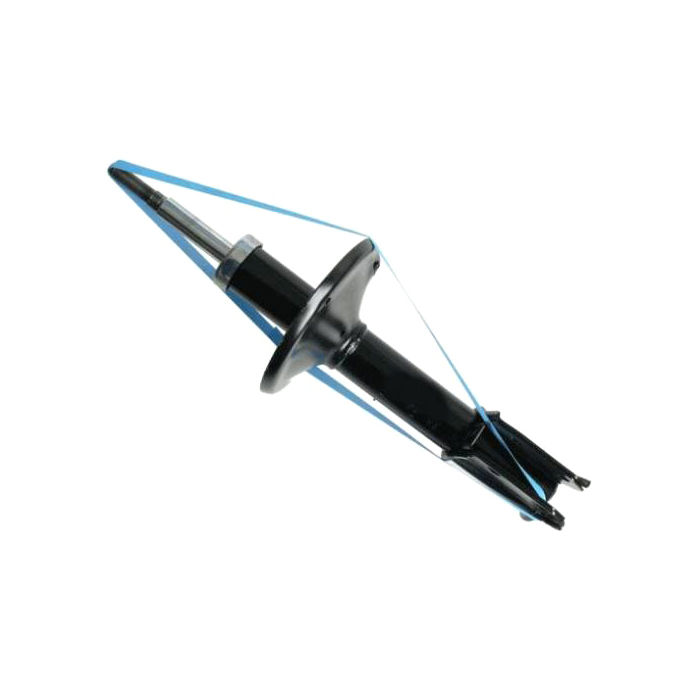 Heavy-Duty Truck Shock Absorbers for Commercial Vehicle ApplicationsReview heavy-duty truck shock absorbers for hydraulic, pneumatic, and air suspension setups, with applications including Dacia Logan and Mitsubishi L200/L300.View Product →
What Advances in Automotive Shock Absorber Technology Mean for Parts Buyers
Specify replacement dampers by measured force and architecture, not by appearance or price band, because the difference between a good and a poor unit stays invisible until the vehicle is loaded. Two supplier questions reveal more than any catalogue photograph: how force is verified on the line, and how the quality control process is documented batch by batch.
- Confirm axle position and cross-reference the original equipment number before discussing price. Front and rear dampers of the same model rarely share a force curve.
- Match architecture to duty cycle. A towing vehicle, a city car and a works van need three different specifications even when the mounting points are identical.
- Request force curves at low and high piston speed, plus the tolerance band. A plus or minus 10 percent window is a reasonable production expectation; vague answers are not.
- Check assembly completeness. Mounts, bearings, bump stops and dust covers add cost, but skipping them shifts failure to the next component up the chain.
- Audit process control before negotiating volume. The published plant equipment list and dyno records tell you whether consistency is designed in or promised verbally.
Frequently Asked Questions
What is the single biggest advance in shock absorber technology?
Fast semi-active control is the most consequential change, because it lets a damper switch between comfort and body control in about 10 milliseconds. Amplitude-selective mechanical valving is the close second, since it delivers a similar benefit in real driving at a fraction of the cost.
Do electronically adjustable dampers last as long as passive ones?
Service life is driven by the same factors as passive units: oil quality, seal design, heat management and road conditions. The electronics add failure points at the valve and the connector, but the mechanical wear inside the damper follows the normal 50,000 to 80,000 km pattern.
Is a monotube damper always better for off-road use?
No. A monotube resists fade better, which matters on long rough stages, but a well-specified twin-tube with foam cells and sufficient oil volume often performs better on cost and comfort. Load, speed and journey length decide the answer, not the format name.
What information should I send a supplier when ordering replacement dampers?
Send the vehicle make, model, model year, body variant, axle position and the original equipment part number, plus the intended duty cycle. Suppliers who ask for force specifications and load data before quoting are usually the ones whose parts fit correctly the first time.
Latest News
-
Advances in Automotive Shock Absorber Technology: What Changed and What to Buy
A 2026-model electric mid-size SUV carries roughly 350 to 400 kg more sprung mass than the combust...2026-10-14
-
The 140th Canton Fair
Heading to Canton Fair 140th 2026 Source factory of auto spare parts. shock absorber Reliable qualit...2026-10-10
-
Key Developments in Automotive Suspension Parts: Trends to Watch in 2026
A workshop in the UK orders a rear damper for a 2012 Audi A4 and receives a twin-tube gas shock wi...2026-10-07
-
Innovations Driving the Automotive Suspension Market: What Buyers Need
Replacing a shock absorber on a 2024 battery-electric sedan is not the same job it was five years ...2026-09-30
-
How Shock Absorbers Improve Vehicle Performance: Damping, Braking & More
At 96 km/h, a family sedan with worn shock absorbers can need roughly six more metres of road to s...2026-09-22
-
Bypass Shocks: Internal vs External Explained for Truck and SUV Owners
When your vehicle’s suspension starts feeling floaty or bottoms out over bumps, the term “bypass sh...2026-09-17
Quick Links
Contact Us
-
 +86-13757453333
 -
 +86-572-8355557
 -
 Caroline@gerep.cn
 -
 No. 36, South Zhenxing Rd., Zhongguan Town, Deqing County, Huzhou, Zhejiang, China
Please Enter Your Information
Copyright © Gerep Automotive Parts Mfg Co., Ltd. All Rights Reserved.
Custom Variable Durable Shock Absorbers Manufacturers
