 EN
 English
 Español


News
 Home / Blogs / Industry News / Latest Trends in Automotive Suspension Systems: 2026 Buyer Guide for Distributors
Latest Trends in Automotive Suspension Systems: 2026 Buyer Guide for Distributors
 2026.10.28
 Industry News
Ask a fleet workshop why a set of dampers came off a vehicle last year and the answer is rarely that they wore out. It is usually that the truck floated when loaded, or that the rear axle stepped sideways on washboard gravel. That shift in vocabulary, from wear to behavior, is the clearest signal of where automotive suspension systems are heading. Damper sheets that once listed one compression curve and one rebound curve are now written as families of curves, selected by valve stack, by solenoid, or simply by frequency.
For anyone who buys, distributes or specifies suspension parts, the consequence is blunt: a part number no longer describes performance on its own. The latest trends in automotive suspension systems all push in the same direction, which is tighter control across a wider range of inputs at a lower unit cost than five years ago. The sections below separate the engineering from the marketing and show what each change means at the purchase order level.
1 to 2 Hz Body bounce frequency the damper must control
10 to 12 Hz Wheel hop band that decides tire contact
0.52 m/s Piston speed used to rate damping force
2 stages Bleed plus blow-off valve stacks now common
What the Latest Trends in Automotive Suspension Systems Change for Buyers
The practical shift is that damping is now tuned across a frequency range rather than at a single test speed, and that tuning is delivered more often inside a sealed assembly than as a bare component.
Frequency selective damping is a passive valve strategy in which a light bleed path absorbs small, high frequency inputs from road texture while a separate blow-off stack controls the larger, low frequency body motions produced by corners, braking and load transfer.
Two mechanical architectures still dominate the aftermarket. A twin-tube damper stores its gas charge in an outer chamber and keeps the working piston inside an inner cylinder. A mono-tube damper separates oil from high pressure nitrogen with a floating piston in a single tube. Mono-tube designs were once a performance-only choice; they now appear across mid-range passenger platforms because a single tube is cheaper to build at volume and sheds heat better under sustained work.
| Architecture | Response character | Best suited to | Main risk to manage |
| Twin-tube, gas in outer chamber | Soft initial response, high compliance | Comfort-biased passenger replacement | Fade under sustained hard use |
| Mono-tube, floating gas piston | Firm and consistent at high piston speed | Performance, off-road, light commercial | Higher gas charge demands a stronger rod seal |
| Frequency selective passive | Soft over small bumps, firm on body motion | Modern passenger platforms and EV conversions | Revalving is difficult and spring match is critical |
| Semi-active electronic | Continuously variable in real time | Premium, performance and adaptive platforms | Depends on sensors and a live control unit |
Read the table as a purchasing filter rather than a ranking. A twin-tube damper matched to the original spring rate will beat a mismatched mono-tube on a comfort-biased vehicle every time, and it will cost the distributor less to hold in stock.
Semi-Active and Adaptive Damping Have Moved Downmarket
Semi-active damping, once reserved for premium flagships, is now specified on mid-range platforms, and the driver is cost structure rather than fashion.
A semi-active damper changes its own valving in milliseconds. Two routes dominate: an electrohydraulic proportional valve that varies a bleed orifice, and magnetorheological fluid whose viscosity changes when a magnetic field is applied. Both depend on body accelerometers and a control unit running a skyhook or comparable algorithm. The hardware bill has fallen far enough that the business case now closes on mid-size sedans and crossovers, not only on luxury SUVs, and the same control hardware is being reused on electrified platforms where a battery pack already raises unsprung mass and ride sensitivity.
Representative rebound force at 0.52 m/s piston speed, in newtons
Twin-tube passenger
1,150
Mono-tube performance
1,600
Off-road damper
2,450
Heavy truck axle
4,700
Values are representative engineering magnitudes for comparison, not published product specifications.
Specification point Force class matters more than body size. A 4,700 N heavy truck damper and a 1,150 N passenger damper can share the same external diameter and the same mounting stud, and only one of them will survive a loaded axle.
The Latest Trends in Automotive Suspension Systems for Off-Road and Heavy-Duty Fleets
Off-road and commercial dampers are growing in piston diameter, travel and oil volume faster than any other segment, and that growth is measurable in hardware rather than in marketing claims.
Piston diameters that sat at 30 to 35 mm a decade ago now commonly run 46 to 60 mm on lifted SUVs, pickups and light commercial vehicles. A larger piston produces the same force at lower internal pressure, which reduces seal stress and heat build-up. Remote reservoirs add oil and gas volume, which delays fade on long corrugated descents. Digressive valving keeps the tire planted over sharp hits without making the vehicle harsh at low speed, and that combination is what professional buyers now expect from a premium off-road damper.
- Larger piston area that lowers internal pressure for the same damping force
- Extra oil volume to delay thermal fade on long gravel descents
- Digressive high speed valving that keeps the tire in contact with the surface
- Nitride or hard chrome rod finish paired with a sealed dust boot
- Reinforced lower mount bushings, the most common failure point on lifted vehicles
Gerep Automotive Parts Mfg Co., Ltd. keeps field notes on how off-road dampers hold stabilizing force on loose surfaces, because that is the property installers complain about when a cheap damper is fitted to a lifted vehicle and the axle starts skipping under braking.
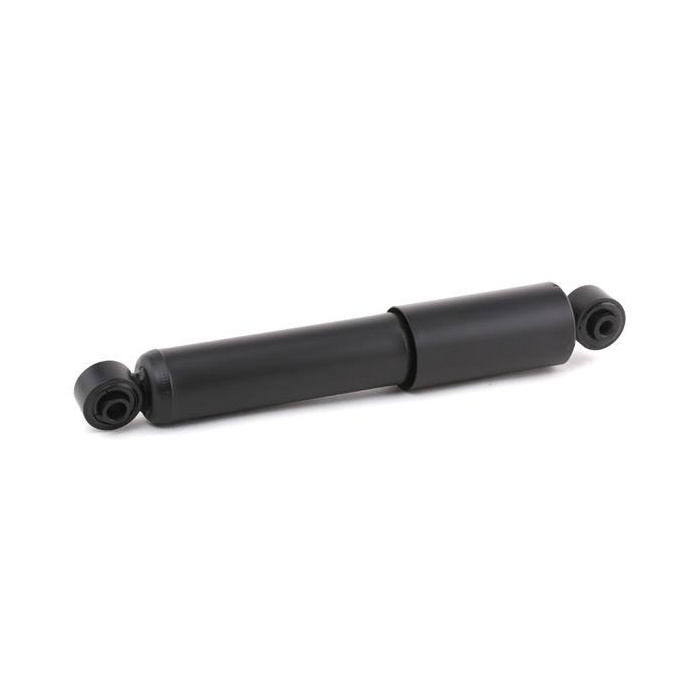
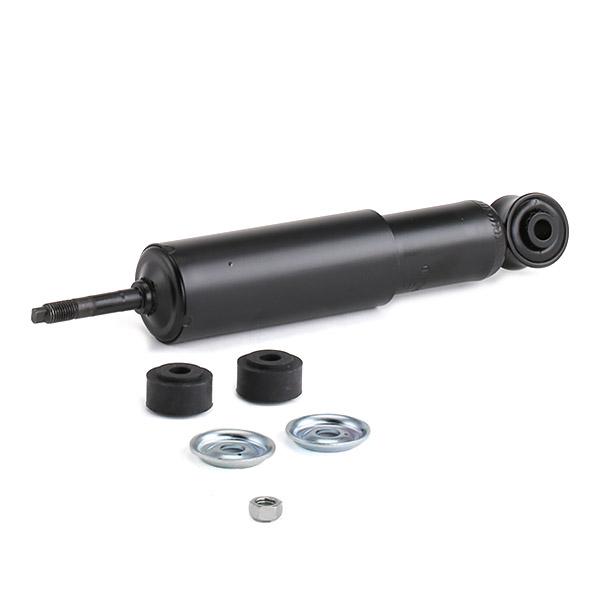
 Toyota Land Cruiser Front Shock Absorber for FJ40 and BJ40Front off-road damper for 1969–1986 Toyota Land Cruiser FJ40 and BJ40/44V, with cross-reference numbers for identifying this replacement fitment.View Product →
Coilover Kits and Strut Assemblies Turn Service Into a Swap
The largest commercial trend is not inside the damper at all. It is the packaging.
Complete strut assemblies ship with the coil spring, upper mount, bearing plate, dust boot and bump stop already fitted. A workshop that replaces a bare damper has to compress the old spring, reuse a mount of unknown age, and accept the risk that a sagged spring will sit the vehicle at the wrong height. An assembly swap removes that risk and typically cuts bay time by half. Coilover kits apply the same logic to adjustability: a threaded body lets the installer set ride height independently of spring preload, which matters when a vehicle carries constant load or runs oversized wheels.
Bare damper replacement
- Lowest unit price per corner
- Existing spring is reused
- Spring and mount condition unknown
- Requires a spring compressor and extra bay time
Complete strut assembly
- Higher unit price, lower total labour
- Spring rate matched by the manufacturer
- New mount, bearing and boot included
- Predictable ride height and faster delivery
For distributors, the stocking decision follows the customer mix. Repair chains that bill by the hour buy assemblies, while performance shops buy adjustable hardware and expect a spring rate recommendation with it.
Sourcing Checkpoints for Aftermarket Suspension Programs
Five checks separate a repeatable suspension program from a one-off shipment that generates returns, and every one of them can be answered before a purchase order is raised.
- Confirm the force class, not only the part number. Two dampers with identical mounting geometry can differ by 40 percent in rated rebound force.
- Verify mount geometry to the millimetre, including stud length, sleeve diameter and the angle of the lower eye.
- Ask what the rod finish and seal compound are. Nitride rods and multi-lip seals are the difference between a 60,000 km service life and a 20,000 km comeback.
- Request batch gas charge records. Inconsistent nitrogen pressure shows up as a vehicle that sits differently from left to right.
- Match spring rate to every coilover kit. A kit sold without a rate recommendation will be returned, usually after it has been installed.
Gerep Automotive Parts Mfg Co., Ltd. publishes its quality control process and plant equipment list so these questions can be answered before an order is confirmed, which is a reasonable minimum for any supplier bidding on a fleet or distributor program.
Frequently Asked Questions
Are electronic dampers worth replacing with standard passive units?
Only if the control unit and sensors are taken out of the loop as well. Fitting a passive damper to a vehicle with a live adaptive controller usually triggers a fault code and leaves the system in a fixed, often firm, default mode. Converting a high volume fleet vehicle to a passive strut assembly that matches the original spring rate is a legitimate cost decision, but it has to be made deliberately and documented for the next owner.
How many kilometres should a heavy truck damper last?
On a loaded axle, plan on 80,000 to 120,000 km for a quality heavy-duty damper and inspect the lower mount bushing at every service interval. Heat ends damper life more often than mileage does, so a vehicle running continuous gradients will need replacements well before a highway unit doing the same distance.
What is the difference between a shock absorber and a strut assembly?
A shock absorber is a damper only. A strut assembly is a structural member that also carries the coil spring, the upper mount and the bearing plate, so it locates the suspension as well as damping it. That structural role is why a worn strut assembly changes ride height and alignment, while a worn rear shock absorber usually changes ride quality alone.
Do coilover kits always lower the vehicle?
No. A threaded body adjusts ride height in both directions within the range allowed by the spring and the damper stroke. Most kits are sold for a modest drop, but a kit with the correct spring free length and stroke can hold factory height or add clearance for a vehicle that runs loaded.
Latest News
-
Latest Trends in Automotive Suspension Systems: 2026 Buyer Guide for Distributors
Ask a fleet workshop why a set of dampers came off a vehicle last year and the answer is rarely th...2026-10-28
-
The Future of Automotive Suspension Technology: Hydraulics, Electronics, Energy Recovery
A workshop quoting dampers for a 2012 Land Cruiser and a 2025 electric crossover is quoting two di...2026-10-21
-
Advances in Automotive Shock Absorber Technology: What Changed and What to Buy
A 2026-model electric mid-size SUV carries roughly 350 to 400 kg more sprung mass than the combust...2026-10-14
-
The 140th Canton Fair
Heading to Canton Fair 140th 2026 Source factory of auto spare parts. shock absorber Reliable qualit...2026-10-10
-
Key Developments in Automotive Suspension Parts: Trends to Watch in 2026
A workshop in the UK orders a rear damper for a 2012 Audi A4 and receives a twin-tube gas shock wi...2026-10-07
-
Innovations Driving the Automotive Suspension Market: What Buyers Need
Replacing a shock absorber on a 2024 battery-electric sedan is not the same job it was five years ...2026-09-30
Quick Links
Contact Us
-
 +86-13757453333
-
 +86-572-8355557
-
 Caroline@gerep.cn
-
 No. 36, South Zhenxing Rd., Zhongguan Town, Deqing County, Huzhou, Zhejiang, China
Please Enter Your Information
Copyright © Gerep Automotive Parts Mfg Co., Ltd. All Rights Reserved.
Custom Variable Durable Shock Absorbers Manufacturers
