 EN
 English
 Español


News
 Home / Blogs / Industry News / The Future of Automotive Suspension Technology: Hydraulics, Electronics, Energy Recovery
The Future of Automotive Suspension Technology: Hydraulics, Electronics, Energy Recovery
 2026.10.21
 Industry News
A workshop quoting dampers for a 2012 Land Cruiser and a 2025 electric crossover is quoting two different engineering problems. The Land Cruiser has to survive corrugated gravel at 3.5 tonnes gross weight; the crossover has to control roughly 400 kg of battery mass sitting low between the axles. In both cases the part that leaves the warehouse will almost certainly be a steel-bodied hydraulic damper with a tuned valve stack. That is the first honest fact about the future of automotive suspension technology: the headline systems are real, but the volume business stays hydraulic for a long time yet.
The Future of Automotive Suspension Technology, Explained Without Hype
Automotive suspension technology is the combination of springs, dampers, locating links, bushings and control electronics that keeps tyres loaded and the body stable under every load case. Its near-term future is not one invention but three tracks running at different speeds: electronic damping control, mass reduction, and energy recovery.
Working definition
A damper converts the kinetic energy of vertical wheel travel into heat by forcing hydraulic fluid through valve orifices. A semi-active damper changes those orifice characteristics in milliseconds. An active system goes further and adds force through a pump or an electric motor.
Deployment is what separates the tracks. SUVs, pickups, vans and mid-range electric cars are absorbing semi-active hardware fastest, because it delivers measurable body control for a fraction of the cost of a fully active system. Luxury platforms and specialist commercial chassis carry the active technology. Meanwhile the installed fleet keeps ageing, and that fleet runs on conventional hydraulics.
12.5 yrs
Approximate average age of light vehicles in service in mature markets, which is why replacement demand rather than new-car specification drives damper sales.
10-20 ms
Typical switching window for a production solenoid valve in a semi-active damper, fast enough to counter body roll mid-corner.
48 V
Electrical architecture that most production active damping and active anti-roll systems rely on to move fluid at useful force levels.
Four Shifts That Will Redefine Damper Design by 2035
Four technologies will shape damper specifications over the next decade, and they will not arrive at the same time or at the same price point.
- Frequency-selective damping becomes the default mid-market valve. A passive valve stack that opens on small, high-frequency inputs and holds firm on slower body motions costs only a small premium over a fixed-rate damper, needs no electronics and fails gracefully.
- Semi-active electronic damping moves down-market. Solenoid-controlled valves, body accelerometers and wheel-travel sensors now appear on mid-size SUVs, pickups and performance electric cars. The control bandwidth is limited to removing energy, but the comfort gain per unit of cost remains the strongest in the industry.
- Fully active systems stay premium. A pump or motor that adds force at each corner can lift a wheel as well as resist it, which suits heavy vehicles, off-road articulation and luxury body control. Cost, power draw and diagnostic complexity keep it out of volume segments.
- Regenerative dampers remain a demonstration technology. Harvesting a few hundred watts on rough roads is technically sound, but the added seals, electronics and validation effort have kept it out of series production so far.
Relative deployment maturity of suspension architectures, 2026 index
Index values describe relative industrial deployment across global light and heavy vehicle platforms. A score of 100 marks a fully industrialized, mass-produced architecture.
Semi-Active or Fully Active: Where Each Architecture Actually Wins
For most buyers the practical choice is not active versus passive, it is semi-active versus a premium passive damper, because that is where the cost per unit of body control is best.
Semi-active damping
- No hydraulic pump or motor, so packaging stays close to a conventional damper.
- Fails safe: a dead valve leaves a fixed, roadworthy damping rate.
- Best value on SUVs, pickups, vans and mid-range electric cars.
- Cannot add force, so it cannot lift a wheel or level a heavy chassis on its own.
Fully active damping
- Adds force at each corner, enabling individual wheel load control and active levelling.
- Requires 48 V or higher electrical architecture plus additional cooling.
- Suits luxury saloons, low-volume performance models and specialist commercial chassis.
- Service cost and diagnostic requirements stay high for the life of the vehicle.
Hybrid approaches are closing the gap. A recent patent filing from Tesla describes a suspension concept that merges spring and damper functions into a single unit, a reminder that packaging, not only control strategy, is now a design battleground. Every architecture change also alters the serviceable item: fewer separate dampers, more sealed assemblies.
What the Future of Automotive Suspension Technology Means for Replacement Parts
Replacement demand, not new-car specification, decides which damper technologies survive commercially, and on that measure hydraulic dampers have decades of runway left.
A vehicle built in 2012 will still be serviced in 2032. Its owner will buy a part that matches the original mounting geometry, not a control strategy. That is why height-adjustable coilover kits and rebuildable monotube dampers hold their value: they are serviceable, they can be revalved, and they fit platforms that were never designed around electronics.
Three specifications decide whether a replacement damper survives its warranty period:
- Mounting geometry and thread type, checked against the original part rather than against the vehicle name.
- Oil volume and gas charge, which set how quickly the unit fades when it is worked hard.
- Corrosion protection, judged by recorded salt-spray hours rather than by a coating description.
Trucks, Road Trains and Off-Road Fleets Pay for Damping, Not Gadgets
On heavy and off-road vehicles, damping is a load-bearing function rather than a comfort feature, and the specification criteria are correspondingly harsher.
250 kg
Weight saved by a composite-intensive truck suspension against a standard steel setup, as reported by Fleet Equipment Magazine. The business case is freight efficiency, not ride quality.
Heavy vehicles rarely need electronic damping to be comfortable. They need dampers that hold their rate across hundreds of thousands of kilometres, resist fade under constant load and can be rebuilt rather than discarded. A road train crossing long distances at steady speed loads its dampers in a way no passenger car ever will, and thermal stability matters more than switchable firmness.
| Vehicle class | Architecture in service today | Dominant wear driver | Buyer's priority |
|---|---|---|---|
| Passenger car | Twin-tube or monotube hydraulic, increasingly frequency-selective | Urban surface quality and annual mileage | Mounting geometry and OE number match |
| Off-road SUV and pickup | High-oil-volume monotube, remote reservoir on uprated builds | Heat build-up on long corrugations | Fade resistance and wheel travel |
| Heavy truck | Heavy-duty hydraulic, often rebuildable | Sustained payload and long duty cycles | Load-bearing capacity and oil volume |
| Road train | Heavy-duty hydraulic with reinforced valving | Continuous high-load towing | Thermal stability under constant load |
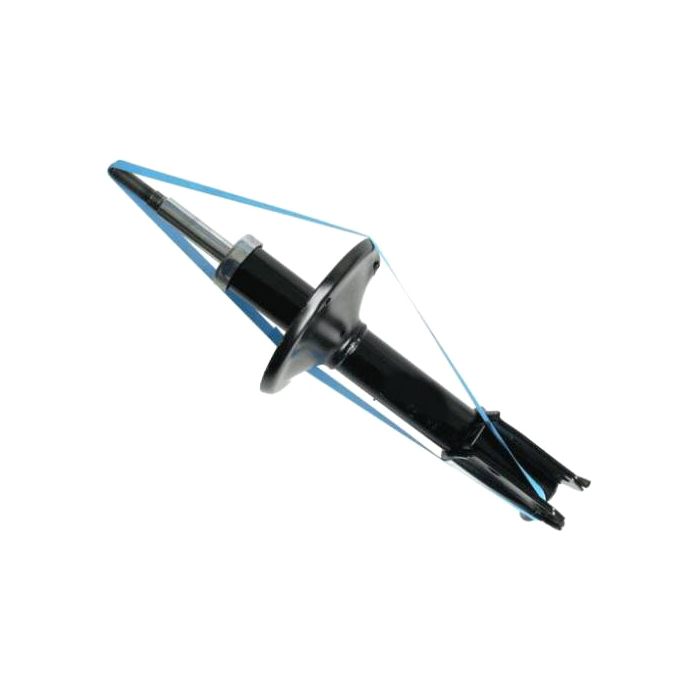 Heavy-Duty Truck Shock Absorbers for Front and Rear ApplicationsBrowse Gerep's heavy-duty truck shock absorber range for front and rear use, including hydraulic, pneumatic, and air suspension options suited to load and road conditions.View Product →
How to Specify Suspension Parts That Stay Serviceable for a Decade
Matching a damper to a vehicle is a five-step verification process, and skipping the first two steps is the most common cause of warranty returns.
- Confirm the vehicle identity first: model, chassis code, model year and axle position. Front and rear units are different parts on almost every platform.
- Match OE reference numbers and mounting dimensions, not catalogue keywords.
- Check oil volume and gas charge against the duty cycle. A damper specified for city driving will fade when it is asked to control a loaded van on a mountain route.
- Choose between a bare damper and a complete strut assembly by comparing labour hours against part cost. Assemblies cut installation time and return risk.
- Write the replacement interval into the maintenance plan so a worn unit is caught before it takes the springs, mounts and tyres with it.
Supplier verification carries as much weight as the specification sheet. Ask for the recorded validation rather than the marketing claim: quality control documentation covering material certificates, salt-spray results and damper dyno curves tells you more about a batch than any brochure.
Suspension Technology Questions Buyers Ask Most
Will active suspension make conventional shock absorbers obsolete?
No. Active systems stay limited to premium, low-volume and specialist commercial vehicles because of cost, power demand and service complexity. The global installed fleet, with an average age above twelve years, will keep consuming conventional hydraulic dampers for at least two more replacement cycles.
What is frequency-selective damping, and is it worth specifying?
It is a passive valve design that opens on small, high-frequency road inputs and stays firm on slower body movements. It delivers a noticeable comfort gain for a small price premium and needs no sensors, wiring or control module, which makes it the lowest-risk upgrade on most platforms.
How long should a replacement damper last?
On passenger cars, 80,000 to 100,000 km is a reasonable benchmark under mixed road conditions; heavy commercial dampers are expected to run considerably further. Real life depends on load, road surface and how much of the vehicle's working life is spent at gross weight.
Do electric vehicles need different shock absorbers?
They need differently tuned dampers. A battery pack adds 300 to 500 kg, lowers the centre of gravity and raises the sprung-to-unsprung mass ratio, so rebound control and low-speed damping must be recalibrated even when the hardware is mechanically similar.
Latest News
-
The Future of Automotive Suspension Technology: Hydraulics, Electronics, Energy Recovery
A workshop quoting dampers for a 2012 Land Cruiser and a 2025 electric crossover is quoting two di...2026-10-21
-
Advances in Automotive Shock Absorber Technology: What Changed and What to Buy
A 2026-model electric mid-size SUV carries roughly 350 to 400 kg more sprung mass than the combust...2026-10-14
-
The 140th Canton Fair
Heading to Canton Fair 140th 2026 Source factory of auto spare parts. shock absorber Reliable qualit...2026-10-10
-
Key Developments in Automotive Suspension Parts: Trends to Watch in 2026
A workshop in the UK orders a rear damper for a 2012 Audi A4 and receives a twin-tube gas shock wi...2026-10-07
-
Innovations Driving the Automotive Suspension Market: What Buyers Need
Replacing a shock absorber on a 2024 battery-electric sedan is not the same job it was five years ...2026-09-30
-
How Shock Absorbers Improve Vehicle Performance: Damping, Braking & More
At 96 km/h, a family sedan with worn shock absorbers can need roughly six more metres of road to s...2026-09-22
Quick Links
Contact Us
-
 +86-13757453333
-
 +86-572-8355557
-
 Caroline@gerep.cn
-
 No. 36, South Zhenxing Rd., Zhongguan Town, Deqing County, Huzhou, Zhejiang, China
Please Enter Your Information
Copyright © Gerep Automotive Parts Mfg Co., Ltd. All Rights Reserved.
Custom Variable Durable Shock Absorbers Manufacturers
