 EN
 English
 Español


News
 Home / Blogs / Industry News / New Technologies in Automotive Suspension Parts: What Buyers Should Know
New Technologies in Automotive Suspension Parts: What Buyers Should Know
 2026.11.18
 Industry News
A 2016 SUV rolls into a workshop with a leaking rear damper. The parts counter looks up one corner of one car and finds four valid references: passive, electronically controlled, sport package, and air-sprung. That single look-up is why new technologies in automotive suspension parts have become a sourcing discipline rather than a catalogue search.
Fifteen years ago a damper was a steel tube with fixed valving and one part number per corner. Today a growing share of the vehicles arriving at workshops leaves the factory with hardware that changes damping force, ride height or spring preload while the vehicle is moving. That hardware fails differently, at different mileages, and at a very different price point.
Working definition
Suspension part technology means any component able to change damping force, ride height or spring rate while the vehicle is driving, instead of relying on one fixed valve setting chosen at the factory.
4 valid replacement references can exist for one damper corner of one model year once electronic damping, sport packages and air suspension appear on the option list.
The Five Technology Families Now Sitting in Replacement Catalogues
Five families cover almost every adaptive system a distributor will be asked to supply, and each one changes the shape of the replacement part rather than only the valving inside it.
| Technology | How it adjusts | Replacement part shape | Buyer watch-out |
| Frequency-selective valving | A secondary valve opens on small, high-frequency road inputs | Ordinary looking damper with a unique internal valve stack | A wrong reference stays invisible until the car is driven |
| Continuous damping control | A solenoid on the damper body varies oil flow in 10 to 20 ms | Damper with solenoid, connector and wiring | Connector and software must match; sensor faults mimic damper failure |
| Magnetorheological damping | A magnetic field changes fluid viscosity in 1 to 5 ms | Sealed damper with an internal coil | Fluid cannot be serviced in the field; the unit is replaced whole |
| Electronic air suspension | Air springs plus adaptive dampers control height and force together | Air spring, damper unit, or both as one assembly | Compressors and height sensors often fail with the spring |
| Coilover kits and strut assemblies | Mechanical or electronic adjustment of height and preload | Complete bolt-on module with spring and top mount | Mounts, bearings and boots should ship in the same box |
Frequency-selective valving is the quietest of the five. From the outside the damper looks conventional, yet a secondary valve opens on coarse asphalt while large inputs still receive full damping force. Because nothing is visible externally, an incorrect reference only reveals itself on the road, which makes accurate fitment data the most valuable asset a supplier can offer.
Reaction Speed: The Number That Sets Every Service Rule
Reaction speed separates these systems, and it also decides how quickly a worn damper turns from a comfort complaint into a safety complaint.
A mechanical frequency-selective valve needs roughly 25 to 30 milliseconds to open or close fully under a step input. An electrohydraulic valve on a continuously controlled damper does the same work in 10 to 20 milliseconds. A magnetorheological damper changes fluid viscosity in 1 to 5 milliseconds, fast enough to respond within a single wheel revolution at highway speed.
Typical reaction time of damping valves, in milliseconds
Mechanical frequency-selective valve
25-30 ms
Electrohydraulic control valve
10-20 ms
Magnetorheological fluid
1-5 ms
Shorter bars mean faster reaction. A passive damper has no adjustment loop at all, so its damping force is fixed at assembly.
1-5 ms
Magnetorheological fluid response
10-20 ms
Electrohydraulic valve response
2-4x
Typical trade price gap between adaptive and passive dampers
12.5 yrs
Average age of passenger cars on European roads
Two consequences follow for anyone buying or fitting these parts. Adaptive dampers work their seals and fluids harder, because the valve cycles thousands of times per minute instead of holding one setting. And a failed solenoid, connector or height sensor produces the same symptom as a worn hydraulic unit, so diagnosis has to start at the electronics before any damper is condemned.
What New Technology in Suspension Parts Changes for Distributors
Adaptive hardware splits one slow-moving reference into a family of low-volume references, and that is where both margin and warranty risk appear.
Passive replacement
- One or two references per axle
- Fits every trim level of the same model
- Wear is progressive and easy to feel
- Labour time is predictable
Adaptive replacement
- Up to four references per corner
- Tied to option codes, not to the model name
- Electronics can fail before the hydraulics
- A relearn may be required after fitting
Strut assemblies reduce risk on the installation side. A complete module that arrives with spring, top mount, bearing and dust boot already assembled takes the spring compressor out of the job and removes the mismatched-component failure behind most early comebacks.
Height-adjustable coilover kits sit at the other end of the same market. They are bought deliberately rather than urgently, usually because the owner wants a specific ride height, spring rate or corner-weight balance instead of an original replacement.
- Fitment data that stops at the model name and never reaches the option code
- Connectors and pin counts that change between model years
- Springs and mounts ordered separately, then ordered twice
- Control modules that need a relearn after a damper change
- Gas charge and rod length that do not match the original specification
Materials and Manufacturing: Where the Real Cost Sits
The differences between a cheap damper and a durable one sit in four places: rod finish, seal compound, fluid quality and gas charge control.
Zhejiang Gerep Automotive Parts Mfg Co., Ltd., trading as Gerep, manufactures passenger car shock absorbers, heavy-duty truck shock absorbers, off-road dampers, road train shock absorbers, strut assemblies and coilover kits from its base in Zhejiang, China, alongside smaller suspension parts such as spring seats, spring discs, brackets and oil pipe brackets. Those peripheral parts matter more than their price suggests: a collapsed spring seat changes the effective spring rate, and a bent bracket changes the angle at which the damper works.
A damper that loses its gas charge in the first 20,000 km is not a wear item. It is a sealing and process-control problem.
Adaptive designs raise the bar again. A piston rod that runs through thousands of valve cycles per minute needs harder chrome and tighter roundness tolerance, and the fluid must resist shear thinning for far longer between services. Buyers assessing a supplier should ask about the production and testing equipment used for rod finishing, seal fitting and gas charging, because those three steps decide service life far more than external appearance.
Where New Suspension Technology Pays Back Fastest: Trucks and Off-Road
Heavy commercial vehicles adopt adaptive damping faster than passenger cars, because the payback is measured in tyre life, cargo protection and driver fatigue rather than in lap times.
A loaded tractor-trailer combination runs at several times the gross weight of any passenger vehicle, and a damper that cannot control axle rebound lets the load oscillate for several cycles after every expansion joint. On long-haul routes that movement shows up as irregular tyre wear, loosened cargo and measurable driver fatigue by the end of a shift.
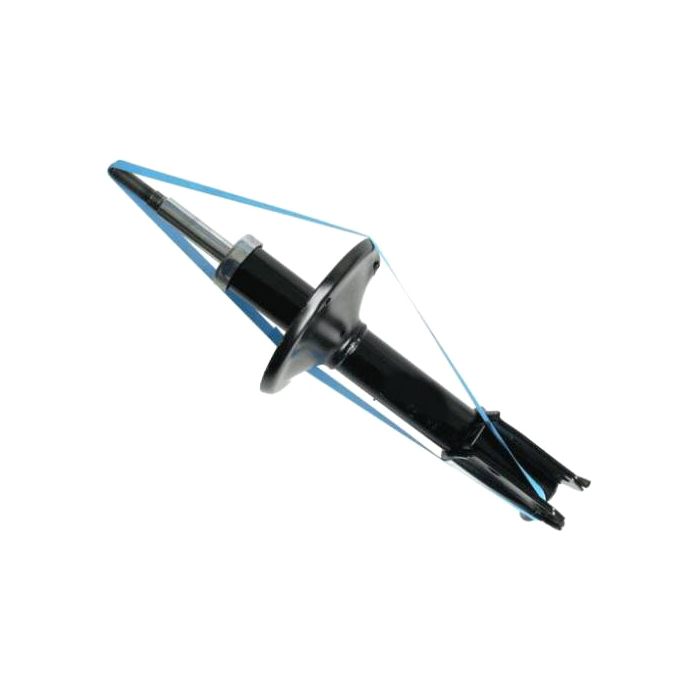 Heavy-Duty Truck Shock Absorbers: Front and Rear FitmentsBrowse model-year front and rear shock absorbers for heavy-duty trucks, including hydraulic, pneumatic and air suspension types for load and road conditions.View Product →
Off-road platforms present the same problem in a different shape: long travel, large oil volumes, higher gas pressures and housings that must survive stone strikes. Vehicles such as the Land Cruiser, Pajero and Cherokee are usually upgraded rather than repaired, so the damper is specified for terrain and load instead of being replaced like for like.
How to Specify a Replacement Damper Without Getting It Wrong
Six checks remove almost every ordering error on vehicles with modern suspension.
- Read the suspension option code, not the trim name on the tailgate.
- Confirm whether electronic damping or air springs are fitted by looking for the connector and the height sensor.
- Decide between a bare damper, a complete strut assembly and a coilover kit before comparing prices.
- Order springs, top mounts, bearings and dust boots in the same shipment.
- Check whether the control module needs a relearn after installation.
- Verify front and rear references separately, even when the vehicle uses the same damper family on both axles.
Frequently Asked Questions
Do adaptive dampers last as long as passive ones?
The hydraulic section of a well-built adaptive damper is comparable to a good passive unit, and most gas-charged dampers show measurable wear somewhere between 80,000 and 120,000 kilometres. The electronics are the variable. Solenoids, connectors and height sensors frequently fail first, and a solenoid fault often appears as a handling complaint long before the damper leaks.
Can a passive damper replace an electronically controlled one?
No. Fitting a passive damper to a vehicle with continuous damping control leaves the control module without feedback, triggers fault codes and can lock the system into a fixed failsafe setting. The correct route is a unit with matching connector and valving, or a conversion kit that includes a module bypass.
Why do identical model year cars need different damper references?
Because damping is specified by option code rather than by model. Sport packages, towing packages, air suspension and all-wheel drive all change spring rate, damper length and valve calibration, so a single model year can carry three or four different rear damper references across its trim levels.
What should an importer ask a suspension parts manufacturer?
Ask for fitment data at vehicle level, including front and rear position, gas charge and seal specification, and evidence of testing against original length and force curves. A manufacturer that publishes its factory equipment and quality process is far easier to audit than one quoting only a price, because the parts of a damper that fail first are exactly the parts that are hardest to inspect on a finished unit.
Latest News
-
New Technologies in Automotive Suspension Parts: What Buyers Should Know
A 2016 SUV rolls into a workshop with a leaking rear damper. The parts counter looks up one corner...2026-11-18
-
The Role of Shock Absorbers in Vehicle Safety: Braking, Grip and Load Control
A shock absorber is not a comfort feature. It is the component that decides whether the tyres keep...2026-11-11
-
Automotive Suspension Systems: New Market Trends Shaping 2026 Buying Decisions
Global automotive suspension systems revenue projections for 2026 range from $52.82 billion to $15...2026-11-04
-
Latest Trends in Automotive Suspension Systems: 2026 Buyer Guide for Distributors
Ask a fleet workshop why a set of dampers came off a vehicle last year and the answer is rarely th...2026-10-28
-
The Future of Automotive Suspension Technology: Hydraulics, Electronics, Energy Recovery
A workshop quoting dampers for a 2012 Land Cruiser and a 2025 electric crossover is quoting two di...2026-10-21
-
Advances in Automotive Shock Absorber Technology: What Changed and What to Buy
A 2026-model electric mid-size SUV carries roughly 350 to 400 kg more sprung mass than the combust...2026-10-14
Quick Links
Contact Us
-
 +86-13757453333
-
 +86-572-8355557
-
 Caroline@gerep.cn
-
 No. 36, South Zhenxing Rd., Zhongguan Town, Deqing County, Huzhou, Zhejiang, China
Please Enter Your Information
Copyright © Gerep Automotive Parts Mfg Co., Ltd. All Rights Reserved.
Custom Variable Durable Shock Absorbers Manufacturers
